Common degu (Octodon degus)
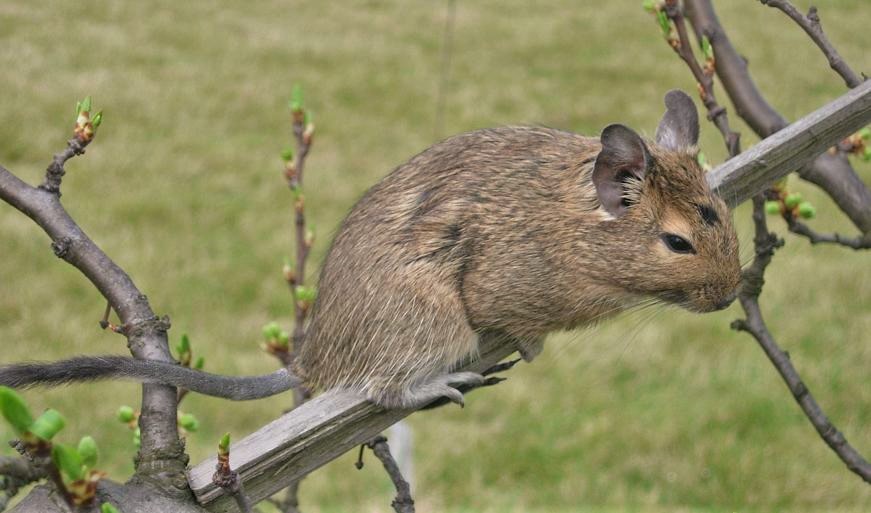
Small mammals · Difficulty: Intermediate
Key facts and care guidance for Common degu (Octodon degus) (origin: Scrubland and slopes of the Andean foothills in west-central Chile.). Adult size around Head-body length 12–20 cm, tail 10–16 cm with a terminal tuft; weight 170–300 g.. Life expectancy 5–8 years, usually 5–7 years.. The values below are carefully researched guidance.
Short answers
Common degu: How big does the enclosure need to be?
From 150×50×150 cm for 2 animals, +20 % for each additional animal (recommended size per the Kaninchenwiese small mammal overview 2025); all levels together should add up to at least 2 m² of floor space (bmt degu leaflet 2023). Legal minimum in Austria 100×50×100 cm per pair plus 20 % per additional animal, Switzerland 0.5 m² for two animals. Wooden wheel with a back wall, at least 30 cm in diameter.
Common degu: What temperature does it need?
Daytime 18–24 °C room temperature; degus tolerate heat poorly – above about 25 °C and in direct sun there is a risk of heatstroke.
Common degu: Does it need UVB lighting?
UVB: Not needed – diurnal, but room light with a natural day-night cycle is enough; a bright spot without direct sun is ideal.
Common degu: How long do they live?
Life expectancy: 5–8 years, usually 5–7 years.
Common degu: Is it suitable for beginners?
Rather not – it is considered an intermediate species (difficulty: Intermediate).
Climate
- Daytime temperature
- 18–24 °C room temperature; degus tolerate heat poorly – above about 25 °C and in direct sun there is a risk of heatstroke.
- Humidity
- 40–60 % (normal indoor air); avoid permanently humid air.
- UVB
- Not needed – diurnal, but room light with a natural day-night cycle is enough; a bright spot without direct sun is ideal.
Enclosure
- Minimum size
- from 150×50×150 cm for 2 animals, +20 % for each additional animal (recommended size per the Kaninchenwiese small mammal overview 2025); all levels together should add up to at least 2 m² of floor space (bmt degu leaflet 2023). Legal minimum in Austria 100×50×100 cm per pair plus 20 % per additional animal, Switzerland 0.5 m² for two animals. Wooden wheel with a back wall, at least 30 cm in diameter.
- Substrate
- At least 10 cm (Austrian minimum), better 20–40 cm deep bedding of small-animal litter with hay and straw for digging; plus a sand bath with chinchilla bathing sand (never bird sand). No cat litter.
Feeding
- Food
- Plenty of high-quality hay daily, grain-free and sugar-free mixes of dried herbs and vegetables, fresh or dried leafy branches (apple, pear, hazel), meadow and kitchen herbs, some carrot or fennel tops and a small portion of vegetables. No fruit and no sweet treats – degus quickly develop diabetes.
- Feeding interval
- Hay and water at all times; dry food once a day, fresh food once or twice a day in small portions. Change diet slowly, as the gut is sensitive.
Key facts
- Adult size
- Head-body length 12–20 cm, tail 10–16 cm with a terminal tuft; weight 170–300 g.
- Life expectancy
- 5–8 years, usually 5–7 years.
- Origin
- Scrubland and slopes of the Andean foothills in west-central Chile.
- Protection status
- No wildlife-protection papers needed, not on the EU invasive species list; not threatened according to the IUCN.
- Brumation
- None – steady room temperature all year round.
- Cohabitation
- Group. Degus are highly social and must never live alone; small groups of 2–4 or more are recommended, e.g. all-female groups, same-sex pairs or a neutered male with several females. Solitary housing is prohibited in Switzerland.
Notes
Degus are escape artists and chew through plastic and soft wood – build enclosures from metal or hard, non-toxic wood. Never hold the tail: the tail skin can tear off (a defence mechanism) and does not grow back.
Do you keep this species?
Add your animal to Reptoria – Reptoria reminds you about feeding and shedding. Add your animal for free →
Related species
- Chinchilla (long-tailed chinchilla) (Chinchilla lanigera) – Intermediate
- African pygmy mouse (Mus minutoides) – Intermediate
- Four-toed hedgehog (African pygmy hedgehog) (Atelerix albiventris) – Intermediate
- Fat-tailed gerbil (Pachyuromys duprasi) – Intermediate
- Gray short-tailed opossum (Monodelphis domestica) – Intermediate
- Cairo spiny mouse (Acomys cahirinus) – Intermediate
- Natal multimammate mouse (Mastomys natalensis) – Intermediate
- Barbary striped grass mouse (Lemniscomys barbarus) – Intermediate
What you need to start
To keep Common degu (Octodon degus) you typically need: a suitable enclosure (from 150×50×150 cm for 2 animals, +20 % for each additional animal (recommended size per the Kaninchenwiese small mammal overview 2025); all levels together should add up to at least 2 m² of floor space (bmt degu leaflet 2023). Legal minimum in Austria 100×50×100 cm per pair plus 20 % per additional animal, Switzerland 0.5 m² for two animals. Wooden wheel with a back wall, at least 30 cm in diameter.), substrate (At least 10 cm (Austrian minimum), better 20–40 cm deep bedding of small-animal litter with hay and straw for digging; plus a sand bath with chinchilla bathing sand (never bird sand). No cat litter.), a heat source with a thermostat, thermometer and hygrometer, a water dish and hides. You will find equipment in the Reptoria marketplace.
The complete, interactive care database is in the Reptoria app.
Last updated: 30 October 2026 · Editor: Reptoria editorial team · Sources include: Wikipedia (de) „Degu“ – 12–20 cm, Schwanz 10–16 cm, besondere Insulinform, Diabetesneigung bei zuckerreicher Ernährung – https://de.wikipedia.org/wiki/Degu, BArtSchV Anlage 1 – Octodontidae nicht gelistet – https://www.gesetze-im-internet.de/bartschv_2005/anlage_1.html, Durchführungs-VO (EU) 2025/1422 (Unionsliste) – Art nicht enthalten – https://umwelt-online.de/recht/eu/25c/25c_1422.htm, VO (EG) 338/97 Anhänge (konsolidiert) – Octodontidae nicht in Anhang A–D – https://www.legislation.gov.uk/eur/1997/338/annex/2020-12-31, Animal Diversity Web, Octodon degus – 170–300 g, tagaktiv, Familiengruppen, Tragzeit 90–95 Tage, 5–8 Jahre in Menschenobhut, IUCN Least Concern – https://animaldiversity.org/accounts/Octodon_degus/
All values are non-binding guidance and do not replace expert advice. Research thoroughly from several sources before acquiring and keeping an animal, and observe the applicable law (species and animal protection in particular).