Barbary striped grass mouse (Lemniscomys barbarus)
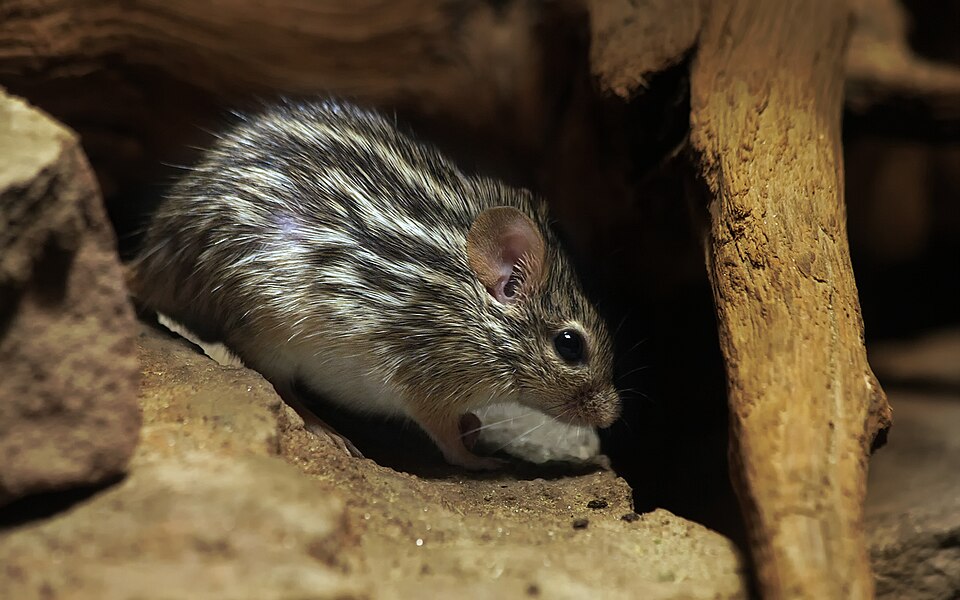
Small mammals · Difficulty: Intermediate
Key facts and care guidance for Barbary striped grass mouse (Lemniscomys barbarus) (origin: Grassland and bush steppe of north-west Africa (Morocco to Tunisia). Animals from sub-Saharan Africa are now regarded as a separate species (Lemniscomys zebra); in the trade both, as well as the spotted striped grass mouse (L. striatus), are sold as 'zebra mouse'.). Adult size around Head-body 9–14 cm, tail about as long; 20–70 g.. Life expectancy Usually 2–2.5 years in human care, individual animals over 4 years.. The values below are carefully researched guidance.
Short answers
Barbary striped grass mouse: How big does the enclosure need to be?
From 100×50×50 cm (zebra mouse leaflet of the Danish welfare organisation Dyrenes Beskyttelse: 100×50 cm floor area and at least 40 cm height for 2 animals, about 20 % more floor area per extra animal). Because they jump well, a closed, well-ventilated terrarium with mesh lid; densely furnished with hay and grass tufts, bark, roots, branches and many hiding places.
Barbary striped grass mouse: What temperature does it need?
Daytime 20–25 °C room temperature; cold and draughts are poorly tolerated, avoid direct sun., at night Not below 18 °C at night.
Barbary striped grass mouse: Does it need UVB lighting?
UVB: Not essential – but as diurnal animals they benefit from a bright spot with daylight or a flicker-free daylight lamp on a 12-hour cycle.
Barbary striped grass mouse: How long do they live?
Life expectancy: Usually 2–2.5 years in human care, individual animals over 4 years.
Barbary striped grass mouse: Is it suitable for beginners?
Rather not – it is considered an intermediate species (difficulty: Intermediate).
Climate
- Daytime temperature
- 20–25 °C room temperature; cold and draughts are poorly tolerated, avoid direct sun.
- Night temperature
- Not below 18 °C at night.
- Humidity
- 40–60 % (normal room air)
- UVB
- Not essential – but as diurnal animals they benefit from a bright spot with daylight or a flicker-free daylight lamp on a 12-hour cycle.
Enclosure
- Minimum size
- from 100×50×50 cm (zebra mouse leaflet of the Danish welfare organisation Dyrenes Beskyttelse: 100×50 cm floor area and at least 40 cm height for 2 animals, about 20 % more floor area per extra animal). Because they jump well, a closed, well-ventilated terrarium with mesh lid; densely furnished with hay and grass tufts, bark, roots, branches and many hiding places.
- Substrate
- 10–15 cm of dust-free wood shavings or small-animal bedding with plenty of hay and straw; hay, grass and leaves for nest building.
Feeding
- Food
- Rodent mix as a base, greens daily (grasses, herbs, carrot, celery), insects once or twice a week (crickets, grasshoppers, mealworms) or some protein food. Unsprayed fruit-tree twigs, a mineral stone and fresh water in a heavy bowl always available.
- Feeding interval
- Once a day in the morning (diurnal species), remove fresh food in the evening.
Key facts
- Adult size
- Head-body 9–14 cm, tail about as long; 20–70 g.
- Life expectancy
- Usually 2–2.5 years in human care, individual animals over 4 years.
- Origin
- Grassland and bush steppe of north-west Africa (Morocco to Tunisia). Animals from sub-Saharan Africa are now regarded as a separate species (Lemniscomys zebra); in the trade both, as well as the spotted striped grass mouse (L. striatus), are sold as 'zebra mouse'.
- Protection status
- Not protected: not on the EU invasive species list, not in the German BArtSchV, the EU wildlife trade regulation or CITES.
- Brumation
- None – keep warm all year.
- Cohabitation
- Group. At least two, more if there is enough space and hiding places; least stressful are same-sex littermates (females usually more peaceful). Introduce unfamiliar adults only gradually; separate immediately in case of serious fights.
Notes
Uncertain identification: several striped grass mouse species are sold as 'zebra mouse' (L. barbarus, L. zebra, L. striatus). Their care hardly differs. The skin comes off easily when grabbed by the scruff or the tail – never hold them that way.
Do you keep this species?
Add your animal to Reptoria – Reptoria reminds you about feeding and shedding. Add your animal for free →
Look for Barbary striped grass mouse (Lemniscomys barbarus) in the marketplace →
Related species
- African pygmy mouse (Mus minutoides) – Intermediate
- Eurasian harvest mouse (Micromys minutus) – Expert
- Fancy mouse (Mus musculus) – Beginner
- Cairo spiny mouse (Acomys cahirinus) – Intermediate
- Natal multimammate mouse (Mastomys natalensis) – Intermediate
- Four-toed hedgehog (African pygmy hedgehog) (Atelerix albiventris) – Intermediate
- Chinchilla (long-tailed chinchilla) (Chinchilla lanigera) – Intermediate
- Common degu (Octodon degus) – Intermediate
What you need to start
To keep Barbary striped grass mouse (Lemniscomys barbarus) you typically need: a suitable enclosure (from 100×50×50 cm (zebra mouse leaflet of the Danish welfare organisation Dyrenes Beskyttelse: 100×50 cm floor area and at least 40 cm height for 2 animals, about 20 % more floor area per extra animal). Because they jump well, a closed, well-ventilated terrarium with mesh lid; densely furnished with hay and grass tufts, bark, roots, branches and many hiding places.), substrate (10–15 cm of dust-free wood shavings or small-animal bedding with plenty of hay and straw; hay, grass and leaves for nest building.), a heat source with a thermostat, UVB lighting, thermometer and hygrometer, a water dish and hides. You will find equipment in the Reptoria marketplace.
The complete, interactive care database is in the Reptoria app.
Last updated: 30 October 2026 · Editor: Reptoria editorial team · Sources include: Dyrenes Beskyttelse, Merkblatt „Zebramus“ – mindestens zu zweit, schrittweise Vergesellschaftung, Haut löst sich bei Griff, Futter, Tragzeit 3–4 Wochen, 4–5 Junge, Lebensdauer 2–2,5 Jahre – https://media.plantorama.dk/cdn/xZ8F25/dyrenes-beskyttelse-zebramus-2013-12-18.pdf, Wikipedia „Barbary striped grass mouse“ – Verbreitung Marokko–Tunesien, subsaharische Populationen jetzt L. zebra, häufig in Menschenobhut gehalten – https://en.wikipedia.org/wiki/Barbary_striped_grass_mouse, BArtSchV Anlage 1 – nur heimische Säugetiere als Sammeleintrag, Lemniscomys nicht genannt – https://www.gesetze-im-internet.de/bartschv_2005/anlage_1.html, Durchführungsverordnung (EU) 2025/1422 – Unionsliste, keine Lemniscomys-Art – https://umwelt-online.de/recht/eu/25c/25c_1422.htm, Species+ (UNEP-WCMC), Abfrage Lemniscomys 29.10.2026 – kein Eintrag (nicht CITES, nicht EU-Anhang A–D) – https://speciesplus.net/api/v1/auto_complete_taxon_concepts?taxonomy=CITES&taxon_concept_query=Lemniscomys
All values are non-binding guidance and do not replace expert advice. Research thoroughly from several sources before acquiring and keeping an animal, and observe the applicable law (species and animal protection in particular).