Chinchilla (long-tailed chinchilla) (Chinchilla lanigera)
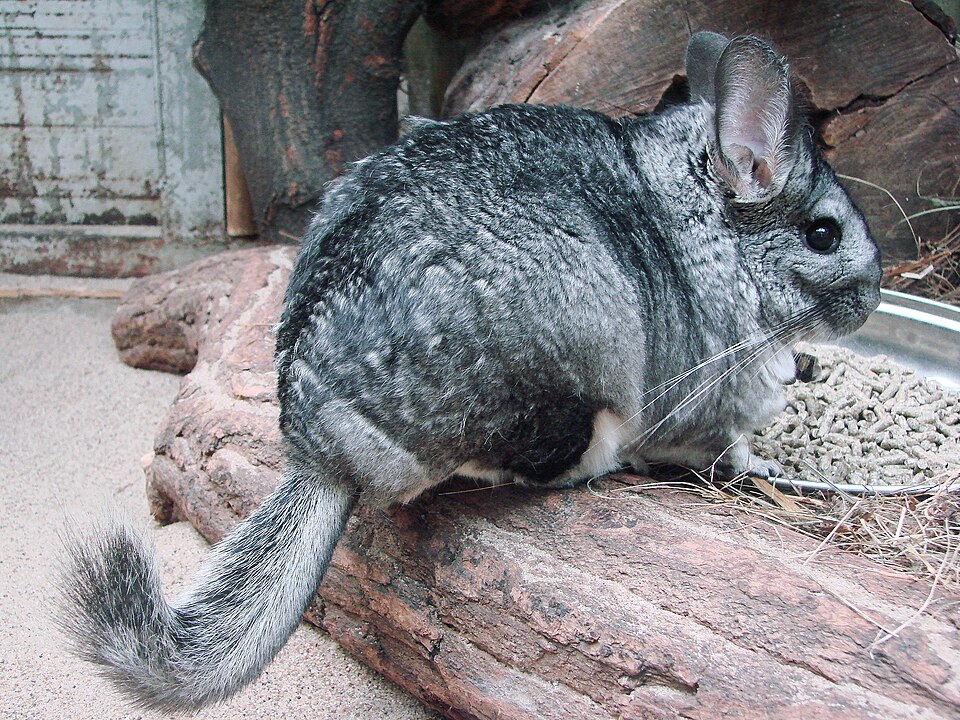
Small mammals · Difficulty: Intermediate
Key facts and care guidance for Chinchilla (long-tailed chinchilla) (Chinchilla lanigera) (origin: Rocky Andean highlands of northern Chile; the wild form is endangered. Pets descend from fur-farm breeding since the 1920s.). Adult size around Head-body length 23–38 cm, tail up to 15 cm; weight 400–800 g, females heavier than males.. Life expectancy 15–20 years – a very long-term commitment.. The values below are carefully researched guidance.
Short answers
Chinchilla (long-tailed chinchilla): How big does the enclosure need to be?
From 200×100×150 cm for 2 animals (recommendation: at least 2 m² of floor area, Kaninchenwiese small mammal overview 2025; minimum framework there 3 m² total area including levels with at least 1 m² floor, 50 cm width and 150 cm height, +0.5 m² per additional animal). Legal minimum in Austria 120×80×100 cm per pair plus 20 % per additional animal. Arrange levels so that no fall of more than 90 cm is possible.
Chinchilla (long-tailed chinchilla): What temperature does it need?
Daytime 18–22 °C room temperature is ideal, at most about 25 °C (MSD: adapted to 18–27 °C). Chinchillas are very sensitive to heat: warmth combined with high humidity can quickly cause heatstroke; choose a cool room in summer.
Chinchilla (long-tailed chinchilla): Does it need UVB lighting?
UVB: Not needed – crepuscular and nocturnal; a normal day-night rhythm in the room is enough, no direct sun on the enclosure.
Chinchilla (long-tailed chinchilla): How long do they live?
Life expectancy: 15–20 years – a very long-term commitment.
Chinchilla (long-tailed chinchilla): Is it suitable for beginners?
Rather not – it is considered an intermediate species (difficulty: Intermediate).
Climate
- Daytime temperature
- 18–22 °C room temperature is ideal, at most about 25 °C (MSD: adapted to 18–27 °C). Chinchillas are very sensitive to heat: warmth combined with high humidity can quickly cause heatstroke; choose a cool room in summer.
- Humidity
- 40–50 % (dry indoor air); high humidity mats the fur and increases the risk of heatstroke.
- UVB
- Not needed – crepuscular and nocturnal; a normal day-night rhythm in the room is enough, no direct sun on the enclosure.
Enclosure
- Minimum size
- from 200×100×150 cm for 2 animals (recommendation: at least 2 m² of floor area, Kaninchenwiese small mammal overview 2025; minimum framework there 3 m² total area including levels with at least 1 m² floor, 50 cm width and 150 cm height, +0.5 m² per additional animal). Legal minimum in Austria 120×80×100 cm per pair plus 20 % per additional animal. Arrange levels so that no fall of more than 90 cm is possible.
- Substrate
- Low-dust small-animal litter or hemp bedding, about 5–10 cm deep; plus a daily sand bath with 5–10 cm of special chinchilla sand (attapulgite, sepiolite or clay mineral, no bird or quartz sand).
Feeding
- Food
- The main food is high-quality hay (at all times) and a varied dried-herb mix; plus small amounts of low-grain chinchilla pellets, dried flowers, gnawing branches (hazel, apple, willow) and a little fresh food such as herbs or lettuce. Dried fruit and nuts only rarely in tiny amounts.
- Feeding interval
- Hay and water at all times; offer herbs and pellets in the evening, fresh food in small portions and changes gradually.
Key facts
- Adult size
- Head-body length 23–38 cm, tail up to 15 cm; weight 400–800 g, females heavier than males.
- Life expectancy
- 15–20 years – a very long-term commitment.
- Origin
- Rocky Andean highlands of northern Chile; the wild form is endangered. Pets descend from fur-farm breeding since the 1920s.
- Protection status
- Pet chinchillas are the domesticated form and need no papers. The wild form is listed as Endangered by the IUCN and is in CITES Appendix I and EU Annex A – wild-caught animals are therefore out of the question.
- Brumation
- None – keep cool to moderate all year, but not below about 10 °C.
- Cohabitation
- Pair. Chinchillas are social and need at least one partner, e.g. same-sex pairs or a neutered male with a female; larger groups only with plenty of space and experience. Austria requires keeping them in pairs.
Notes
No plastic in the enclosure, wood non-toxic and untreated. Daily free-roaming in the evening in a secured room (cables, plants). When handled roughly, chinchillas shed patches of fur ('fur slip') – it takes months to grow back.
Do you keep this species?
Add your animal to Reptoria – Reptoria reminds you about feeding and shedding. Add your animal for free →
Look for Chinchilla (long-tailed chinchilla) (Chinchilla lanigera) in the marketplace →
Related species
- Common degu (Octodon degus) – Intermediate
- African pygmy mouse (Mus minutoides) – Intermediate
- Four-toed hedgehog (African pygmy hedgehog) (Atelerix albiventris) – Intermediate
- Fat-tailed gerbil (Pachyuromys duprasi) – Intermediate
- Gray short-tailed opossum (Monodelphis domestica) – Intermediate
- Cairo spiny mouse (Acomys cahirinus) – Intermediate
- Natal multimammate mouse (Mastomys natalensis) – Intermediate
- Barbary striped grass mouse (Lemniscomys barbarus) – Intermediate
What you need to start
To keep Chinchilla (long-tailed chinchilla) (Chinchilla lanigera) you typically need: a suitable enclosure (from 200×100×150 cm for 2 animals (recommendation: at least 2 m² of floor area, Kaninchenwiese small mammal overview 2025; minimum framework there 3 m² total area including levels with at least 1 m² floor, 50 cm width and 150 cm height, +0.5 m² per additional animal). Legal minimum in Austria 120×80×100 cm per pair plus 20 % per additional animal. Arrange levels so that no fall of more than 90 cm is possible.), substrate (Low-dust small-animal litter or hemp bedding, about 5–10 cm deep; plus a daily sand bath with 5–10 cm of special chinchilla sand (attapulgite, sepiolite or clay mineral, no bird or quartz sand).), a heat source with a thermostat, thermometer and hygrometer, a water dish and hides. You will find equipment in the Reptoria marketplace.
The complete, interactive care database is in the Reptoria app.
Last updated: 2 November 2026 · Editor: Reptoria editorial team · Sources include: Wikipedia (en) „Long-tailed chinchilla“ – CITES Anhang I, domestizierte Exemplare nicht erfasst, Tragzeit 110–124 Tage – https://en.wikipedia.org/wiki/Long-tailed_chinchilla, BArtSchV Anlage 1 – Chinchillidae nicht gelistet – https://www.gesetze-im-internet.de/bartschv_2005/anlage_1.html, CITES CoP9 (1994), Änderungen der Anhänge – Anmerkung zur domestizierten Form von Chinchilla spp. – https://cites.org/sites/default/files/eng/cop/09/E9-Amend-to-AppI-II.pdf, Durchführungs-VO (EU) 2025/1422 (Unionsliste) – Art nicht enthalten – https://umwelt-online.de/recht/eu/25c/25c_1422.htm, VO (EG) 338/97 Anhänge (konsolidiert) – „Chinchilla spp. (I) (Specimens of the domesticated form are not subject to this Regulation)“ – https://www.legislation.gov.uk/eur/1997/338/annex/2020-12-31
All values are non-binding guidance and do not replace expert advice. Research thoroughly from several sources before acquiring and keeping an animal, and observe the applicable law (species and animal protection in particular).