Golden hamster (Syrian hamster) (Mesocricetus auratus)
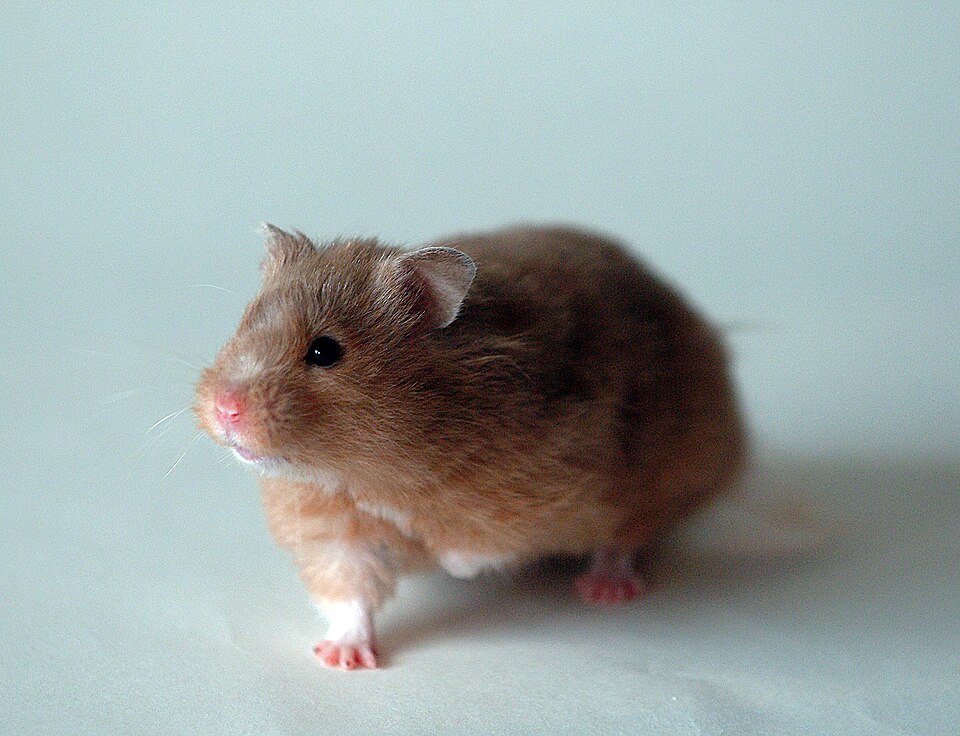
Small mammals · Difficulty: Beginner (but not for children under about 12 – nocturnal)
Key facts and care guidance for Golden hamster (Syrian hamster) (Mesocricetus auratus) (origin: North-western Syria and adjacent southern Turkey (Aleppo plateau); all pet hamsters descend from a litter caught in Syria in 1930.). Adult size around Head-body length about 13–18 cm, tail about 1.5 cm; weight 80–160 g, females usually slightly heavier.. Life expectancy 2–3 years, rarely up to 4 years.. The values below are carefully researched guidance.
Short answers
Golden hamster (Syrian hamster): How big does the enclosure need to be?
From 100×80×70 cm (bmt hamster leaflet 2025, the bigger the better; the Swiss animal protection society STS and a study by Fischer et al. 2007 recommend 1 m² of continuous floor space). TVT leaflet no. 156 is cited with at least 100×50×50 cm and a wheel of at least 30 cm diameter with a solid running surface. Legal minimums are far smaller (Switzerland 1,800 cm², Austria 60×30×40 cm) and are only an absolute lower limit.
Golden hamster (Syrian hamster): What temperature does it need?
Daytime 18–24 °C room temperature (bmt hamster leaflet 2025); in the cold activity drops to near immobility, above 26 °C heat stress is likely.
Golden hamster (Syrian hamster): Does it need UVB lighting?
UVB: Not needed – nocturnal mammal; normal daylight in the room with a regular day-night rhythm is enough; do not place the enclosure in direct sun.
Golden hamster (Syrian hamster): How long do they live?
Life expectancy: 2–3 years, rarely up to 4 years.
Golden hamster (Syrian hamster): Is it suitable for beginners?
Yes – it is considered suitable for beginners (difficulty: Beginner (but not for children under about 12 – nocturnal)).
Climate
- Daytime temperature
- 18–24 °C room temperature (bmt hamster leaflet 2025); in the cold activity drops to near immobility, above 26 °C heat stress is likely.
- Humidity
- 40–60 % (normal indoor air, no extra humidification).
- UVB
- Not needed – nocturnal mammal; normal daylight in the room with a regular day-night rhythm is enough; do not place the enclosure in direct sun.
Enclosure
- Minimum size
- from 100×80×70 cm (bmt hamster leaflet 2025, the bigger the better; the Swiss animal protection society STS and a study by Fischer et al. 2007 recommend 1 m² of continuous floor space). TVT leaflet no. 156 is cited with at least 100×50×50 cm and a wheel of at least 30 cm diameter with a solid running surface. Legal minimums are far smaller (Switzerland 1,800 cm², Austria 60×30×40 cm) and are only an absolute lower limit.
- Substrate
- At least 20 cm, better 40 cm deep bedding (bmt) of small-animal litter mixed with hay and straw, pressed down in places so tunnels hold; Swiss law requires at least 15 cm. With 40–80 cm hamsters dig natural burrows and hardly gnaw the bars any more (Hauzenberger et al. 2006). Add a sand bath with low-dust sand.
Feeding
- Food
- Hamster seed mix of grains, seeds, dried vegetables and herbs as the base, hay at all times, a little fresh food daily (herbs, lettuce, vegetables such as cucumber or carrot), gnawing branches. About once a week a small amount of animal protein (e.g. dried insects, mealworms, low-fat quark). Scatter food so the hamster has to search for it.
- Feeding interval
- Feed daily in the evening (dry and fresh food); remove fresh leftovers in the morning. Hamsters hoard food – only check the hoard for perishables.
Key facts
- Adult size
- Head-body length about 13–18 cm, tail about 1.5 cm; weight 80–160 g, females usually slightly heavier.
- Life expectancy
- 2–3 years, rarely up to 4 years.
- Origin
- North-western Syria and adjacent southern Turkey (Aleppo plateau); all pet hamsters descend from a litter caught in Syria in 1930.
- Protection status
- No wildlife-protection papers needed, not on the EU invasive species list. The wild form is listed as Vulnerable by the IUCN; pets are exclusively captive-bred.
- Brumation
- None – do not allow winter rest indoors. Below about 8–10 °C a torpor can set in, which is dangerous for pets; warm the animal up slowly and consult a vet.
- Cohabitation
- Solitary. Golden hamsters are strict loners and often seriously injure other hamsters, including siblings; Swiss law even requires solitary housing.
Notes
Hamster balls, multi-level cages with little floor space and wheels under 30 cm are unsuitable. Coat varieties such as teddy or rex hamsters are partly criticised as harmful breeding. Do not wake the animal during the day.
Do you keep this species?
Add your animal to Reptoria – Reptoria reminds you about feeding and shedding. Add your animal for free →
Look for Golden hamster (Syrian hamster) (Mesocricetus auratus) in the marketplace →
Related species
- Campbell's dwarf hamster (Phodopus campbelli) – Beginner
- Chinese hamster (Chinese striped hamster) (Cricetulus griseus) – Beginner
- Djungarian hamster (winter white dwarf hamster) (Phodopus sungorus) – Beginner
- Roborovski dwarf hamster (Phodopus roborovskii) – Beginner (purely an animal to watch)
- African pygmy mouse (Mus minutoides) – Intermediate
- Four-toed hedgehog (African pygmy hedgehog) (Atelerix albiventris) – Intermediate
- Chinchilla (long-tailed chinchilla) (Chinchilla lanigera) – Intermediate
- Common degu (Octodon degus) – Intermediate
What you need to start
To keep Golden hamster (Syrian hamster) (Mesocricetus auratus) you typically need: a suitable enclosure (from 100×80×70 cm (bmt hamster leaflet 2025, the bigger the better; the Swiss animal protection society STS and a study by Fischer et al. 2007 recommend 1 m² of continuous floor space). TVT leaflet no. 156 is cited with at least 100×50×50 cm and a wheel of at least 30 cm diameter with a solid running surface. Legal minimums are far smaller (Switzerland 1,800 cm², Austria 60×30×40 cm) and are only an absolute lower limit.), substrate (At least 20 cm, better 40 cm deep bedding (bmt) of small-animal litter mixed with hay and straw, pressed down in places so tunnels hold; Swiss law requires at least 15 cm. With 40–80 cm hamsters dig natural burrows and hardly gnaw the bars any more (Hauzenberger et al. 2006). Add a sand bath with low-dust sand.), a heat source with a thermostat, thermometer and hygrometer, a water dish and hides. You will find equipment in the Reptoria marketplace.
The complete, interactive care database is in the Reptoria app.
Last updated: 30 October 2026 · Editor: Reptoria editorial team · Sources include: Animal Diversity Web, Mesocricetus auratus – Allesfresser inkl. Insekten, Einzelgänger, Torpor unter 8 °C, Lebensdauer 2–2,5 Jahre – https://animaldiversity.org/accounts/Mesocricetus_auratus/, MSD Veterinary Manual, Disorders and Diseases of Hamsters – Wet Tail/Lawsonia, Milben, Tumoren, giftige Antibiotika – https://www.msdvetmanual.com/all-other-pets/hamsters/disorders-and-diseases-of-hamsters, Wikipedia (de) „Goldhamster“ – Verbreitung Syrien/Türkei, IUCN gefährdet, Abstammung aller Heimtiere von 1930 – https://de.wikipedia.org/wiki/Goldhamster, BArtSchV Anlage 1 – Mammalia spp. nur heimische Arten, Mesocricetus auratus nicht gelistet (nur M. newtoni) – https://www.gesetze-im-internet.de/bartschv_2005/anlage_1.html, Durchführungs-VO (EU) 2025/1422 (Unionsliste) – Art nicht enthalten – https://umwelt-online.de/recht/eu/25c/25c_1422.htm
All values are non-binding guidance and do not replace expert advice. Research thoroughly from several sources before acquiring and keeping an animal, and observe the applicable law (species and animal protection in particular).