Djungarian hamster (winter white dwarf hamster) (Phodopus sungorus)
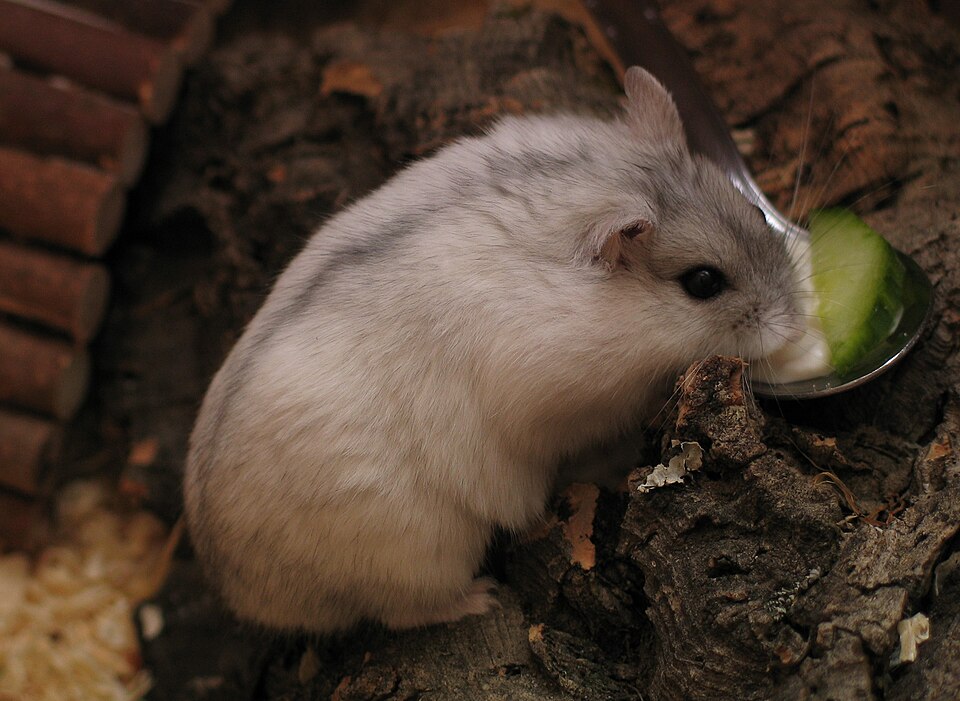
Small mammals · Difficulty: Beginner
Key facts and care guidance for Djungarian hamster (winter white dwarf hamster) (Phodopus sungorus) (origin: Steppes of north-eastern Kazakhstan and south-western Siberia.). Adult size around Head-body length 7–9 cm, tail 0.5–1.5 cm; weight usually 30–50 g, lighter in winter.. Life expectancy 2–3 years.. The values below are carefully researched guidance.
Short answers
Djungarian hamster (winter white dwarf hamster): How big does the enclosure need to be?
From 120×50×50 cm (recommended size per the Kaninchenwiese small mammal overview 2025; bmt hamster leaflet 2025: the enclosure must not be smaller than 100×50×50 cm, TVT leaflet no. 162 dwarf hamsters 2025). Bigger is better; the Austrian legal minimum is only 60×30×40 cm. Wheel at least 25 cm (Roborovski at least 20 cm) with a solid running surface.
Djungarian hamster (winter white dwarf hamster): What temperature does it need?
Daytime 18–24 °C room temperature (bmt hamster leaflet 2025); in the cold activity drops to near immobility, above 26 °C heat stress is likely.
Djungarian hamster (winter white dwarf hamster): Does it need UVB lighting?
UVB: Not needed – nocturnal mammal; normal daylight in the room with a regular day-night rhythm is enough; do not place the enclosure in direct sun.
Djungarian hamster (winter white dwarf hamster): How long do they live?
Life expectancy: 2–3 years.
Djungarian hamster (winter white dwarf hamster): Is it suitable for beginners?
Yes – it is considered suitable for beginners (difficulty: Beginner).
Climate
- Daytime temperature
- 18–24 °C room temperature (bmt hamster leaflet 2025); in the cold activity drops to near immobility, above 26 °C heat stress is likely.
- Humidity
- 40–60 % (normal indoor air, no extra humidification).
- UVB
- Not needed – nocturnal mammal; normal daylight in the room with a regular day-night rhythm is enough; do not place the enclosure in direct sun.
Enclosure
- Minimum size
- from 120×50×50 cm (recommended size per the Kaninchenwiese small mammal overview 2025; bmt hamster leaflet 2025: the enclosure must not be smaller than 100×50×50 cm, TVT leaflet no. 162 dwarf hamsters 2025). Bigger is better; the Austrian legal minimum is only 60×30×40 cm. Wheel at least 25 cm (Roborovski at least 20 cm) with a solid running surface.
- Substrate
- At least 20 cm, ideally 30–40 cm deep bedding of small-animal litter with hay and straw for digging, plus a sand bath with low-dust chinchilla sand (essential for coat care). Do not place heavy objects on the deep bedding – risk of collapse.
Feeding
- Food
- Dwarf hamster mix of fine seeds, grass seeds and dried herbs (sugar-free and low in grain), hay, a little fresh food daily such as herbs, lettuce or cucumber, gnawing branches. Several times a week a small amount of animal protein (dried insects, mealworms, low-fat quark). No fruit and no sweet treats.
- Feeding interval
- Feed daily in the early evening and scatter the food; remove fresh leftovers the next morning.
Key facts
- Adult size
- Head-body length 7–9 cm, tail 0.5–1.5 cm; weight usually 30–50 g, lighter in winter.
- Life expectancy
- 2–3 years.
- Origin
- Steppes of north-eastern Kazakhstan and south-western Siberia.
- Protection status
- No wildlife-protection papers needed, not on the EU invasive species list; not threatened according to the IUCN.
- Brumation
- None – keep at a steady room temperature indoors. Short torpor in cold and short days is possible but undesirable for pets.
- Cohabitation
- Solitary. According to the bmt leaflet, dwarf hamsters should only be kept alone; pairs and groups often get along for a long time and then suddenly escalate with serious injuries. Austria allows pairs, but solitary housing is the less stressful option.
Notes
Often confused or crossed with Campbell's dwarf hamster in the trade; hybrids may carry hereditary disease and a tendency to diabetes – ask about origin when buying. In short days the coat turns white ('winter white'), often not under artificial light. Recent taxonomy places the species in the genus Cricetiscus.
Do you keep this species?
Add your animal to Reptoria – Reptoria reminds you about feeding and shedding. Add your animal for free →
Look for Djungarian hamster (winter white dwarf hamster) (Phodopus sungorus) in the marketplace →
Related species
- Campbell's dwarf hamster (Phodopus campbelli) – Beginner
- Roborovski dwarf hamster (Phodopus roborovskii) – Beginner (purely an animal to watch)
- Chinese hamster (Chinese striped hamster) (Cricetulus griseus) – Beginner
- Golden hamster (Syrian hamster) (Mesocricetus auratus) – Beginner (but not for children under about 12 – nocturnal)
- Fancy mouse (Mus musculus) – Beginner
- Fancy rat (Rattus norvegicus) – Beginner
- Mongolian gerbil (Meriones unguiculatus) – Beginner
- African pygmy mouse (Mus minutoides) – Intermediate
What you need to start
To keep Djungarian hamster (winter white dwarf hamster) (Phodopus sungorus) you typically need: a suitable enclosure (from 120×50×50 cm (recommended size per the Kaninchenwiese small mammal overview 2025; bmt hamster leaflet 2025: the enclosure must not be smaller than 100×50×50 cm, TVT leaflet no. 162 dwarf hamsters 2025). Bigger is better; the Austrian legal minimum is only 60×30×40 cm. Wheel at least 25 cm (Roborovski at least 20 cm) with a solid running surface.), substrate (At least 20 cm, ideally 30–40 cm deep bedding of small-animal litter with hay and straw for digging, plus a sand bath with low-dust chinchilla sand (essential for coat care). Do not place heavy objects on the deep bedding – risk of collapse.), a heat source with a thermostat, thermometer and hygrometer, a water dish and hides. You will find equipment in the Reptoria marketplace.
The complete, interactive care database is in the Reptoria app.
Last updated: 30 October 2026 · Editor: Reptoria editorial team · Sources include: bmt e. V., Flyer „Hamster als Haustiere“ (2025) – Zwerghamster ausschließlich einzeln, Gehege nicht unter 100×50×50 cm, Chinesischer Zwerghamster mind. 120 cm Länge, Sandbad, hohe Einstreu, 18–24 °C – https://bmt-tierschutz.bmtev.de/lib_dateien/Flyer_Hamster_2025.pdf, MSD Veterinary Manual, Disorders and Diseases of Hamsters – Durchfall, Milben, Tumoren, Atemwegserkrankungen – https://www.msdvetmanual.com/all-other-pets/hamsters/disorders-and-diseases-of-hamsters, Wikipedia (en) „Djungarian hamster“ – Hybriden mit Campbell, Größe 70–90 mm, Lebensdauer 1–3 Jahre, Sozialprobleme bei Paarhaltung – https://en.wikipedia.org/wiki/Djungarian_hamster, BArtSchV Anlage 1 – Phodopus/Cricetulus nicht gelistet, Mammalia spp. nur heimische Arten – https://www.gesetze-im-internet.de/bartschv_2005/anlage_1.html, Durchführungs-VO (EU) 2025/1422 (Unionsliste) – Art nicht enthalten – https://umwelt-online.de/recht/eu/25c/25c_1422.htm
All values are non-binding guidance and do not replace expert advice. Research thoroughly from several sources before acquiring and keeping an animal, and observe the applicable law (species and animal protection in particular).